

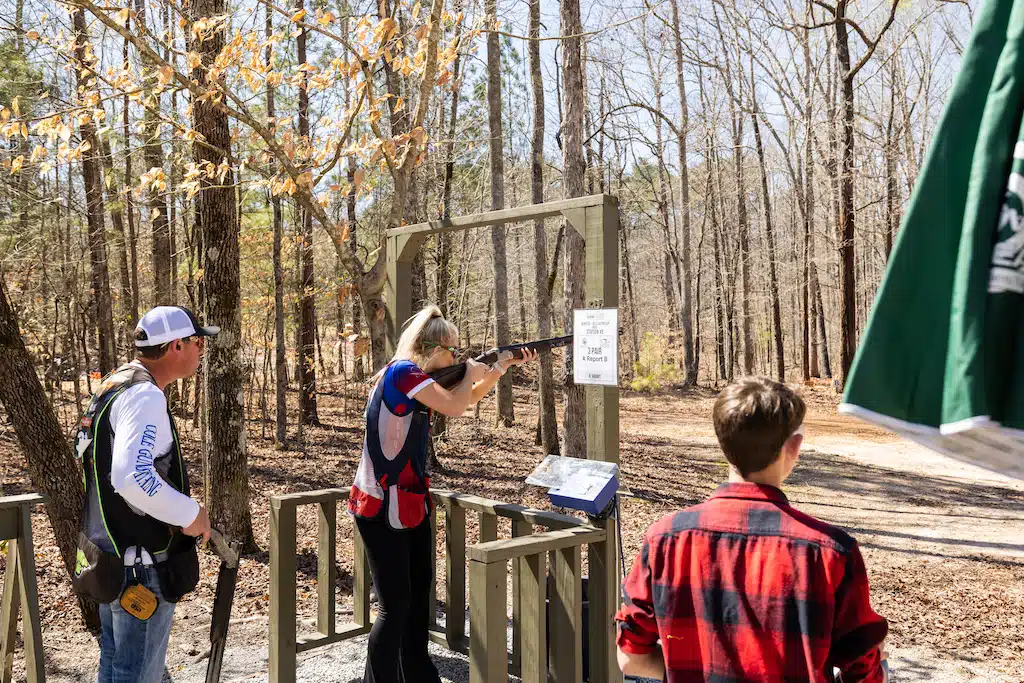

If you’ve searched “skeet shooting near me” around Atlanta, you’ve probably noticed that people use “skeet,” “clays” and “trap” almost interchangeably. They’re related, since all three involve breaking clay targets with a shotgun, but each one feels different once you’re standing at the station.
Here’s a plain-language guide to how sporting clays and skeet compare, where 5-stand and helice fit in, and how to choose your next round. If you love skeet and want something new, we think you’ll find a lot to like about sporting clays at Cherokee Rose, about 35 miles south of Atlanta in Griffin, Georgia.
The quick difference
- Skeet is shot on a standardized field. Every regulation skeet field is laid out the same way, so the targets are the same from field to field. It’s about repetition, rhythm and precision.
- Sporting clays is shot on a course that winds through natural terrain. Each station shows different targets at different angles, speeds and distances, and no two courses are alike. It’s often called “golf with a shotgun.”
Think of skeet as a driving range where you groove the perfect swing. Sporting clays is the golf course, where every hole asks something new.
Side-by-side comparison
| Skeet | Sporting clays | |
|---|---|---|
| Layout | One standard semicircular field with two target houses (the “high house” and “low house”) | A walking course of stations spread across fields and woods |
| Stations | 8 shooting positions on the same field | Varies by course. At Cherokee Rose, each course has 16 stations with four target machines per station. |
| Targets | Standard targets on fixed, crossing flight paths | Varied presentations: crossers, incomers, going-away, high and low, often with different target sizes and speeds |
| Predictability | Very predictable. You know exactly where each target will fly. | Less predictable. Each station is a new puzzle. |
| Pace | A squad shoots a round together, rotating through the stations on one field | Squads move station to station, like a round of golf, on foot or by golf cart |
| Round size | Typically 25 targets per round | Commonly 50 or 100 targets |
| Feel | Practice-like, focused and repetitive | Outdoorsy, varied, closer to field hunting |
| Governing body (US) | National Skeet Shooting Association (NSSA) | National Sporting Clays Association (NSCA) |
Course layout and stations
Skeet: one field, eight positions
A skeet field is a semicircle with a target house at each end. The high house throws from an elevated window and the low house throws from close to the ground. Shooters move through eight positions, seven around the arc plus one in the middle. Targets from both houses cross over a fixed point in the middle of the field. Because every regulation field is built to the same standard, skeet rewards building a consistent, repeatable technique.
Sporting clays: a course through the countryside
A sporting clays course is designed by people who want each station to feel different. Course setters use the land itself: hills, trees, water and open fields. They choose target angles that mimic game birds and other field shots.
At Cherokee Rose, that land is 124 acres of rolling Georgia terrain with pines, ponds and streams. There are two 16-station courses:
– The Creek Course is the most popular, with targets that can be enjoyed from beginner to expert.
– The Rose Course has more diverse targets, with shots that are longer and faster, for more of a challenge.
Target presentations and difficulty
In skeet, you learn the “picture” of each target and work toward breaking it the same way every time. That consistency makes skeet a great discipline for learning gun mount, lead and follow-through.
Sporting clays mixes it up. In a single round you might see a fast crosser over a pond, a target dropping through the trees, then a pair that comes at you together. It’s harder to predict, which is exactly why many shooters love it. Every round feels new, and every course is different.
Is sporting clays harder than skeet? Most shooters find sporting clays more varied and less predictable. That’s not the same as harder for everyone, though. Courses are set with a range of targets, and Cherokee Rose’s Creek Course is designed with beginners in mind. Skeet’s challenge is chasing perfect scores on targets you know by heart.
Guns and chokes
You can shoot both sports with the same shotgun. Over/unders, semi-autos and pumps are all common.
- Skeet targets are usually broken at fairly close range, so shooters often use open chokes.
- Sporting clays targets range from close to far, so many shooters use interchangeable choke tubes and adjust them by station, or settle on a versatile middle-ground choke.
If you’re bringing your own gun to Cherokee Rose, review the sporting clays safety guidelines before your visit. Barrels must be over 24 inches. Use lead target loads in 7.5, 8 or 9 shot only, with no steel shot, slugs, buckshot or hunting loads. No home-defense, pistol-grip or AR-style shotguns are allowed. Don’t have a shotgun? Rental shotguns are available. See rental and target pricing.
Scoring
In both sports, your score is the number of targets you break.
– Skeet is scored per 25-target round, and serious skeet shooters chase “straights,” meaning 25 for 25.
– Sporting clays is scored across the whole course, commonly 50 or 100 targets. Because every course is different, scores are best compared on the same course on the same day.
At Cherokee Rose, the target machines run on a card that counts the targets thrown. The team is glad to explain the card system and review safety before you head out.
Who each sport is for
Skeet may be a great fit if you:
– Love repetition and measurable progress
– Want to practice the same shots until they’re automatic
– Enjoy a quick, compact round on one field
Sporting clays may be a great fit if you:
– Hunt and want practice that looks like real field shots
– Get bored of seeing the same target twice
– Want a social, outdoor few hours with friends, family or coworkers
– Are planning a group event. A round of 50 clays typically takes 60–90 minutes, and 100 clays usually takes 2–2.5 hours.
Where 5-stand and helice fit
5-stand: the bridge between skeet and sporting clays
5-stand gives you sporting-clays-style variety in a compact layout. Shooters rotate through five stands, and targets come from several machines set up around the field. It’s a great warm-up and a natural next step for skeet shooters, since you stay in one spot but see sporting-style targets. Cherokee Rose has a covered 5-stand used for warm-ups and private instruction.
Helice: the wild card
Helice (sometimes called ZZ birds) is something else entirely. The targets are white plastic caps attached to orange propellers, launched from machines spinning at 5,000 rpm, so each one flies an unpredictable path, much like a live bird. The goal is to knock the white cap off before the target clears the fence, and you get two shells per bird.
Cherokee Rose became the first and only United States Helice Association (USHA) regulation ring in Georgia in January 2021. The ring is open for practice during regular hours, and a casual helice group meets on Sunday mornings. Learn more on the Helice page.
Coming from skeet? Here’s how to get started at Cherokee Rose
- Start on the Creek Course. It’s the most popular course and has targets for every level, which is a comfortable way to learn how sporting stations work.
- Warm up on the 5-stand. It feels familiar and is a good primer for varied target presentations.
- Take a lesson. Resident NSCA-certified instructors work with shooters at every level, including experienced shotgunners crossing over from other disciplines. See the instruction page to book.
- Bring the right gear. Eye and ear protection are required for everyone. Read what to wear clay shooting near Atlanta for a full checklist.
- Bring the crew. Cherokee Rose hosts corporate, charity and private events. Request a date for your group.
Cherokee Rose is open to the public Wednesday–Sunday, 9 AM–6 PM, at 895 Baptist Camp Rd., Griffin, GA 30223. Check the calendar for course closures, or call the clubhouse at 770-227-6569.
Sporting Clays vs. Skeet: FAQs
Is sporting clays the same as skeet?
No. Both involve shooting clay targets with a shotgun, but skeet is shot on a standardized field with fixed target paths, while sporting clays is shot on a course with varied targets across natural terrain.
Which is better for beginners, skeet or sporting clays?
Both are beginner-friendly with a little guidance. Skeet’s predictable targets are good for learning fundamentals. Sporting clays courses usually include easier stations, too. At Cherokee Rose, the Creek Course is designed to be enjoyed by beginners through experts, and lessons are available.
Can I use my skeet gun for sporting clays?
Usually, yes. Most shotguns used for skeet work for sporting clays. Many shooters add interchangeable chokes for longer targets. At Cherokee Rose, check the safety guidelines for barrel length and ammo rules.
What’s the difference between skeet and trap?
In trap, targets are thrown away from the shooter from a single house in front of the shooting line. In skeet, targets cross from two houses on either side of the field. Sporting clays mixes many kinds of presentations on one course.
Is 5-stand closer to skeet or sporting clays?
5-stand sits in between. You shoot from fixed stands like skeet, but the targets have sporting clays variety. Cherokee Rose has a covered 5-stand.
Where can I shoot clays near Atlanta?
Cherokee Rose Sporting Clays is about 35 miles south of Atlanta in Griffin, GA. It offers two 16-station sporting clays courses, a covered 5-stand and Georgia’s first USHA regulation Helice ring, and it’s open to the public Wednesday–Sunday.